Otranto is the most eastern point of the boot, the city of the Martyrs, a jewel of Salento, a bridge between the West and the East, a territory full of Caribbean beaches, a place rich in history, art, culture. But it is also much more.
Otranto derives from the word Hydruntum, which indicates a small river that crosses the Idro valley, although some schools of thought believe that instead it may derive from the name with which it indicated a hill that stood near the port area, called Odronto. Numerous hamlets also belong to the municipal area, some of which are also requested tourist destinations, such as Porto Badisco, Fontanelle, Serra Alimini, Frassanito, Conca Specchiulla.
It immediately catches the eye how Otranto is a fortified city, whose ancient village is enclosed by the defensive walls that allow access to its interior through the Porta Alfonsina. The geographical position has in fact always represented a double-edged sword, an opportunity but also a threat to the city since for a long time it has been one of the most important cultural and commercial centers of Salento.
It all started when Greek colonists founded the village, in full expansion of what would later be known as Magna Grecia. Over the centuries Otranto was conquered by the Lombards, Byzantines, Angevins, Aragoneses and Turks, only to end up under the reign of Venice and later in the French hands. A long series of peoples and dominions alternated in the control of the city. Even today the signs of these passages are clearly distinguishable and it can be seen in the artistic treasures, in the culture, in the architectural works that have come to the present day.
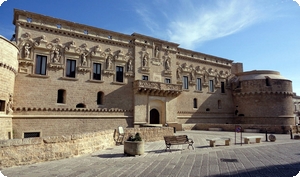
One of these testimonies is undoubtedly the imposing Aragonese Castle, an ancient military fortress designed by Ciro Ciri and built between 1485 and 1498 by Fernando I D'Aragona, on the basis of military buildings already present by Svevi prima and Turchi then. The castle has a pentagonal plan surrounded by a protective moat, has three angular cylindrical towers and a large coat of arms belonging to Charles V above the main entrance. It is currently used as a splendid theater for exhibitions and cultural events.
From the square where the castle stands, located in the east of the city, the labyrinth of narrow streets and alleys that make up the ancient village, the oldest and most characteristic part of the city, begin to branch out. Walking along these streets gives the impression of being brought back in time, with the houses, the stairs, the courtyards, the shops, the atmospheres of the past. It is a pleasure to untangle among the thousand small streets and discover hidden scenarios.
Not far from the Castle we find the Cathedral of Santa Maria Annunziata, another fantastic work of immense artistic and historical value, dating back to the 11th century. The church preserves the remains of the massacre of the 800 faithful who, during the invasion of the Turks in 1480, tried to resist not wanting to deny their faith. The massacre of the martyrs of Otranto is one of the most painful and sad pages of the city and admiring the Chapel of the Martyrs inside the Cathedral is an absolutely special experience. Another treasure kept in the church is the floor mosaic, a true masterpiece depicting the Tree of Life, considered by many experts to be an encyclopedia of Christianity. In fact, it depicts many episodes of the Old Testament and in general the path that man must take to purify himself from original sin and achieve eternal salvation; it also contains many pagan references and numerous traces of the symbolic historical role that Otranto played as a bridge between the West and the East.
Another religious structure to visit is the Church of San Pietro, characterized by a Byzantine Greek cross architecture and famous for the wealth of frescoes kept in it. The name is due to the belief that St. Peter passed right here on his way from Palestine to Rome. In any case, it is the oldest church in Otranto, tracing its central core back to the 5th century.