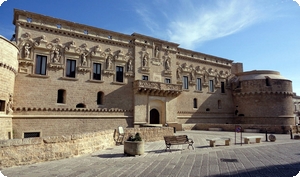
Gallipoli, with its historic center which stands on a limestone island and which seems to grasp the waters of the Ionian Sea, is one of the most renowned tourist destinations in Salento. Its name derives from "Kale polis", a name arrived from colonists from Greece, and means "beautiful city". Although it is believed that the ancient name of the city, in Messapian times, was "Anxa", which would mean "village that rises in a place raised by the sea".
And its beauty has always attracted the attention of many peoples.
After the occupation of the Barbarians and the brief Byzantine, Gallipoli was rebuilt during the domination of the Roman Empire of Onesti, which fortified the city and the defensive walls. With them began the most recent history of the city, which moreover intervened by creating communication systems, such as the connection between Gallipoli and the Via Traiana which ensured a rapid passage to the Balkans.
Subsequently, after the Norman occupation and the various short dominations, the city passed under Spanish domination and in this period artisan activities grew in the city. From the 16th century it became the main square in Europe for the production and export of lampante oil, so much so that on the London Stock Exchange the price of the oil was established on the basis of the Gallipoli quotations.
In the Bourbon period the city port was built and Gallipoli became the district capital. The new landing place flanked the old one (the fishing port) which stands near the Greek Fountain and close to the Rivellino, almost on the border (marked by a brick bridge of the 1600s) between the modern village and the old city. With the unification of Italy it became the provincial capital with Lecce and Taranto.
Gallipoli offers many ideas to tourists. Its history highlights, as already said, a considerable commercial and strategic importance.
The castle, one of the most important in Salento, is a majestic fortress suspended over the sea that marks the entrance to the old city. The building has Byzantine origins but underwent radical changes and renovations in the Angevin and Aragonese periods, when a fence with a polygonal plan fortified by cylindrical towers was built. In the upper part of the tower there were still the original catapults and cannons used to defend the city. In 1522 the eastern curtain called Rivellino was built, detached from the perimeter of the fortress and isolated in the waters. Access to the Rivellino is allowed via an existing wooden drawbridge.
Countless are the ramparts and towers built to defend the city over the centuries (bastion of angels, bastion of S. Domenico, bastion of souls, bastion of S. Francesco, Torre del Pizzo, Torre San Giovanni la Pedata, Torre Sabea for mention a few). Not least are the noble buildings that were built and inhabited by the lords of the time (Pirelli palace, Assanti-Aragona palace, Specolizzi palace, seminary palace, etc.).
And not least are the religious structures, many of which enriched with a variant of the Lecce Baroque with original features, the Gallipoli Baroque. Among them we can mention some such as the Co-Cathedral Basilica of Sant'Agata, the Church of S. Francesco di Paola, the Church of S. Francesco d'Assisi, the Church of Santa Maria della Purità.
The greek fountain, perhaps the oldest in Italy and probably dating back to the 3rd century BC, deserves a special mention. The façade, which looks like a sirocco, is divided into three parts by four caryatids that support the architrave with a rich decoration and it is about 5 meters high. In the bas-reliefs, obtained from slabs of local hard stone, scenes representing the three metamorphoses of the mythological Dirce, Salmace and Biblide are carved. While on the other facade, built with the function of support in 1765, there are the coat of arms of Gallipoli, an epigraph in Latin and the insignia of the sovereign Charles III of Bourbon. Below is the drinking trough where the animals quenched their thirst in the past.