Maglie is an important center of southern Salento and rises in a valley whose margins are of modest relief. In this area there have been finds of human presence since the prehistoric period, paleolithic age. At the same time, several megaliths, such as dolmens and menhirs, can be traced back to the countryside around Maglie; one of them shows evident primitive signs.
There are several hypotheses on the origins of Maglie, but all of them have been denied by recent studies, according to which the name Maglie derives from the term "mal", which means high ground. It is therefore an oronym, as in the case of other Salento towns (Matino, Monteroni, Montesano, Montesardo) which, despite being in flat territory, include in their toponym the meaning of a geographical conformation that does not really exist. The name of the city already appears in medieval texts: from a thirteenth-fourteenth century Malle passed to the curial fifteenth century Mallie, Mallia, Mallye, Malie, and finally Maglie, the current one.
From the prehistoric evidence that has come down to us, it is certain that the area has been inhabited since the Iron Age. It was under the dominion of several barons, first the Lubello who administered the city for four centuries and built the first castle. Later on it passed to other feudal families, among which the Filomarino, and finally the Capece.
The latter certainly deserve a separate mention in the inlay of the history of Maglie. The last feudal lords of Maglie have given the propulsive push to make the country one of the most important centers of the Land of Otranto and all of Salento by increasing agriculture, crafts, industry and culture. If today Maglie is one of the most important villages on the peninsula, it is certainly due to the Capece family and the people are aware and grateful for it.
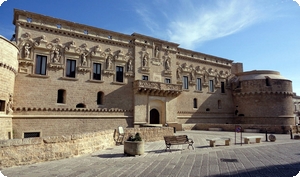
The baronial palace of the Capece family is not a municipal seat and this is a detail that opens the door to a history of culture and civilian life. The palace was probably born as an Angevin fortress, almost certainly suffered serious damage due to the looting of the Ottoman people and was reborn first with the Lubello family. It was later demolished and rebuilt with a noble garment by the Duke Filomarino, while the important Baroque portal is owed to the Capece family.
The last baroness of Maglie, Francesca Capece, donated her home to the people so that young people could study and educate themselves. Today it is the seat of the Liceo Classico named after the noblewoman.
The people of Maglie have always been grateful to Baroness Capece and to pay homage to her she dedicated a statue of considerable prestige and workmanship to her. This statue, in white Carrara marble, is certainly the most important work of the Salentine sculptor Antonio Bortone who wanted to immortalize the woman at the end of his life while giving a young boy with a shield in his hand (representation of the city) a cross and a book, respectively symbols of faith and wisdom.
Despite being a town with a fairly recent history, the city offers several ideas for the tourist who decides to visit it. Among them we can certainly include the large underground oil mill, recently brought to light and renovated. Then continue with the important Civic Museum of Paleontology and Palethnology, mainly dedicated to the reconstruction of the Salento prehistory and a reference point for the knowledge of the most remote past of Southern Italy thanks to its pleistocene faunas and anthropic finds.
In the historic center of Maglie there are important architectural monuments of great artistic and cultural interest such as the church of Santa Maria della Scala, the church of Santa Maria delle Grazie and the cathedral. All splendid examples of early '500 and late' 700 architecture, strongly influenced by the Lecce Baroque school. The Duomo or Collegiate Church deserves special mention, also called the "big church", with the spectacular wooden choir of the late eighteenth century.
But the imposing Lecce stone column located in the outlets of the church of Santa Maria delle Grazie, whose origin or foundation date is not known, should not be forgotten either. It is believed that the column, which now serves as a base for the modern statue of the Virgin of Grace with Child, dates back to the end of the seventeenth century, but the estimate was made only thanks to the similarities with that which holds the statue of Sant'Oronzo in the square of the same name in Lecce.