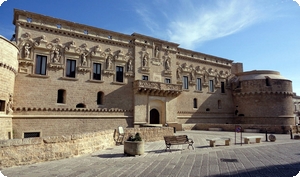
Lecce is a city rich in Salento history and culture. It was born on an ancient Messapian settlement, as evidenced by the finds of tombs and parts of the walls.
During the 2nd century BC the city of Lecce was called Lupiae and at that time it emerged on the other centers of the territory, becoming first a municipality and then a colony. During the rule of Hadrian's empire, the great amphitheater, the theater and the road that connected Lecce with the port of Hadrian, known today as Marina di San Cataldo, were built. Subsequently with the emperor Marcus Aurelius, Lecce acquired economic well-being and experienced a strong building expansion. Except for a short period of Greek domination, Lecce remained under the control of the Romans for about five centuries. This flourishing period was followed by a slow decline of about five centuries during which various dominations followed (Ostrogoths, Byzantines, Saracens, Longobards, Hungarians and Slavs).
It was the Norman conquest that revived Lecce, as a commercial center, and extended its territory to become the capital of Salento. In fact, starting from Goffredo d'Altavilla the Norman counts kept there court and here was born the last Norman king, Tancredi of Lecce, who obtained the title of count of Lecce. Tancredi, natural son of Roger III of Puglia and Emma daughter of Accardo II count of Lecce, would later become king of Sicily. And to him must be recognized the construction of the church of S.S. Niccolò and Cataldo, which has now become one of the most important medieval monuments in southern Italy.
Following the domination of the Normans, the Swabians followed and then the Angevins. During the XV century, Lecce became an important commercial center and in a short time it became a fulcrum of cultural wealth that characterized Salento. Thanks to Charles V, the Salento Renaissance period arrived in Salento. The Castle, the walls, a Triumphal arch (built to remember Charles V and today known as Porta Napoli) and the Hospital of the Holy Spirit were built.
In 1592 the Seat was built in Piazza S. Oronzo, also called with the name of Seggio, and around 1660 it was followed by the column of S. Oronzo, current patron of the city.
During the Spanish period, the city became an important artistic and cultural center, second only to the city of Naples. In this period Lecce was enriched with beautiful buildings and monuments in Baroque art such as the churches of S. Teresa, S. Chiara, S. Angelo (just to name a few), the Palazzo dei Celestini and the splendid Piazza Duomo. In the latter place there are numerous monuments harmoniously linked by a single style, the Baroque; you can admire the Cathedral, the beautiful bell tower, the Seminary and the Bishop's Palace.
The Bourbon domination began in 1734 with King Charles III who soon passed to the throne of Spain and subsequently with Ferdinand IV. With the Bourbons there was a period of economic growth, changes were made to the administrative structure, the privileges and immunities of the clergy were limited and the rich wealth of the Jesuits was requisitioned.
A breath of fresh air was brought by Napoleon's brother-in-law Gioacchino Murat and the revival of the economy occurred mainly during the Napoleonic period thanks to important measures such as the abolition of feudalism, the restructuring of large estates and a more adequate distribution of public lands. The abolition of feudalism did not mean the end of the nobility, which continued to dominate for most of the nineteenth century, even after the unification of Italy.
When in 1860 King Francesco II of the Two Sicilies fell under the Garibaldi conquest, Salento was annexed to the kingdom of Italy and on 20 March 1865 it obtained administrative autonomy with the creation of the province of Lecce, which traced the boundaries of the ancient Land of 'Otranto.
From this historical summary you can imagine how beautiful and interesting to visit the city of Lecce (also known as the Florence of the south, thanks above all to its splendid Baroque works). So do not give up on visiting it, dedicate one day to discover its ancient treasures.