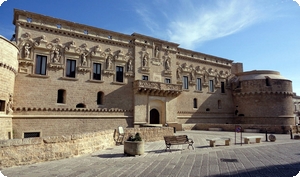
Corigliano d'Otranto is one of the municipalities of the Salento Grecìa known for its historical center and for its castle, defined as the "most beautiful monument of military and feudal architecture in Terra d'Otranto". Its name can be traced back to the Byzantine Greek term "choríon" with the meaning of village, town, farm, land or place.
The menhirs, the mirrors and the dolmens testify that the place has been inhabited since ancient times. Among the latter, the great "Caroppo 1" and "Caroppo 2" deserve special mention; the first consists of four rooms each covered with a stone slab while the second is characterized by a single room with the same type of roof. These are Neolithic testimonies among the most famous for their almost intact state of conservation.
The foundation of the country is uncertain and could date back to the Magna Graecia period, the Roman one or even the pre-Roman one with the Messapi. The Basilian monastery of San Giorgio built in the 9th century and in which a school of Greek language and Byzantine culture that left numerous Greek codes, now kept in important libraries, contributed to the development of the small center. He also lived the Norman domination and of various lords belonging to the most illustrious families of the time.
The village of Corigliano d'Otranto is a treasure trove of architectural, environmental and archaeological treasures. Walking in its historic center you can admire the Mother Church of San Nicola, built in 1622 on a pre-existing structure of which some remains remain. The portal, in fact, dates back to 1573 and is surmounted by the statues of the Redeemer, the Madonna and San Nicola di Mira. The bell tower is also from an earlier period (dating back to 1465) and is located a short distance from the church. Inserted in the medieval city walls, it was originally used as a lookout tower.
Other important religious buildings are the Church of Addolorata, built in neo-Gothic style between the 1920s and 1960s. The Church of the Madonna delle Grazie, dating back to the first half of the 18th century, built on the ruins of an older sanctuary and of which it conserves a Byzantine fresco of the Madonna of Constantinople. The chapel of the Madonna degli Angeli, built between the 16th and 17th centuries, consists of a single room covered by a barrel vault with lunettes. And finally the Chapel of San Leonardo, built around the second half of the fifteenth century and consisting of an east-facing nave covered by a barrel vault, an eight-spoke rose window and a small bell tower.
Also noteworthy are the various noble palaces built between the 16th and 19th centuries, among which we can list Palazzo Comi, Palazzo Peschiulli and Palazzo de 'Monti.
A very important monument is the Arco Lucchetti of 1497, the highest expression of local culture, consisting of three monolithic elements in Lecce stone. It was built in 1497 by the owner of the building, as he himself declares in one of the inscriptions that are engraved on it. The arch leads into a courtyard in which sixteenth-century Latin inscriptions engraved on the lintels of the doors can be glimpsed. The entire decoration refers to medieval models and a sentimental story emerges from it thanks to the Byzantine symbols of a man's love for his bride.
But among the most fascinating attractions, one cannot forget the Castello de' Monti, a dwelling with a medieval layout that was the subject of a profound military renovation by the de’ Monti family, feudal lords of the area in the 15th century. The castle has a quadrangular layout with four corner towers and a deep moat. Each tower has the heraldry of the de' Monti accompanied by the allegorical representations of the four cardinal virtues and the bas-reliefs of as many Saints under whose protection each of them is placed. The central body is advanced compared to the entrance portal and is surmounted by a balcony and three niches which contain the statues of the feudal lord, of charity and justice. Its military function ceased, in the mid-seventeenth century the castle was adapted, according to the fashion of the time, to aesthetic and representational needs of the feudal lord's family. In fact, Duke Francesco Trane enriched the portal with baroque elements and allegorical figures on the windows, as well as with the busts of the great leaders of the past. Today the drawbridge no longer exists and has been replaced by a stone one.